




Truck Side Guard (Side Underrun Protection) System Guide: Components, Materials & Installation
Introduction: What Is a Truck Side Guard?
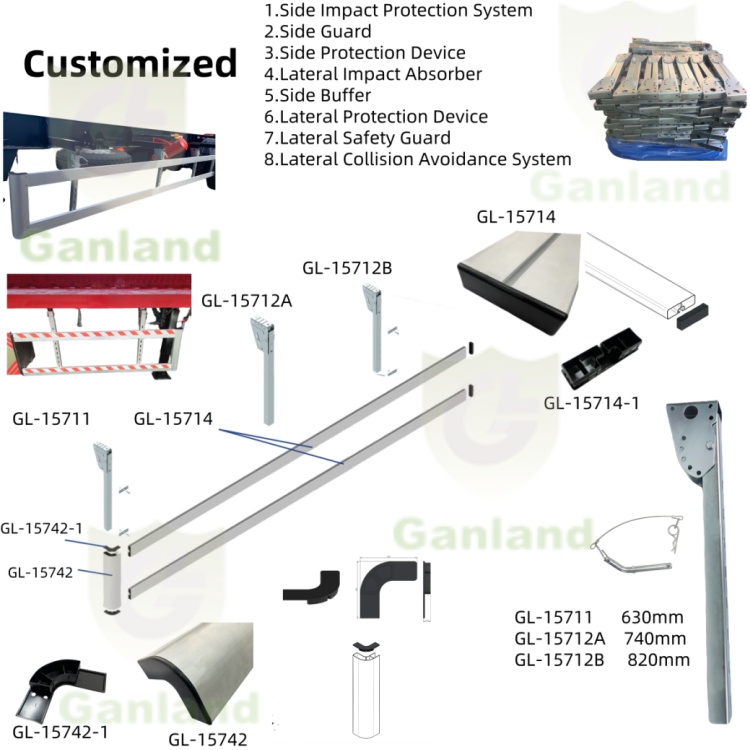
A truck side guard - also called a side underrun protection system (SUPS), side protection device, or side guard - is a protective frame fitted along the side of a truck or trailer, between the front and rear wheels. It consists of horizontal aluminum rails, corner profiles and vertical steel mounting brackets, forming a barrier that closes the dangerous gap under the vehicle body.
In the curtain sider and trailer industry, the side guard is a standard safety component: it prevents pedestrians, cyclists and motorcyclists from being pulled under the vehicle in a collision, protects fuel tanks and chassis components, and is legally required on many commercial vehicles in Europe and other regions.
1. What Does a Side Guard Do? The Key Functions
1.1 Protecting Vulnerable Road Users
The primary function is underrun protection. In the event of a side collision with a pedestrian, cyclist or motorcyclist, the side guard absorbs the impact and prevents the person from being dragged under the wheels. This is the reason side guards are legally mandated on heavy commercial vehicles.
1.2 Protecting the Vehicle Itself
- Shields fuel tanks, air tanks and electrical harnesses from impact
- Prevents minor collisions from damaging chassis components
- Reduces repair costs from kerb, bollard and low-object strikes
1.3 Regulatory Compliance
In the European Union, UN Regulation No. 73 (lateral protection devices) requires side guards on most commercial vehicles with a gross vehicle mass above 3.5 tonnes. The regulation specifies:
- Device must run from near the front axle to near the rear axle
- Lower edge must be no more than 550 mm above ground
- The outer surface must be smooth and continuous
- Specific strength requirements to resist 2 kN lateral force
Many other markets (including parts of the Middle East, Africa and South America) have adopted or reference similar requirements, so side guards are increasingly standard equipment on export trucks and trailers.
1.4 Loading and Aesthetics
Beyond safety, side guards give the vehicle a finished, professional appearance and can carry company branding - many fleets use the guard surface for logos and hazard striping.
2. Complete Component List: What Makes Up a Side Guard
| Component | Model No. | Material | Key Specifications | Function |
| Horizontal aluminum rail | GL-15714 | Aluminum | 100mm W x 30mm H, wall 1.5mm, 1.3 kg/m, 8.5mm T-slot opening | Main horizontal barrier along the vehicle side |
| Rail end cap | GL-15714-1 | Plastic | 100 x 29.25 x 21.50mm, 18g | Seals rail ends; prevents water ingress and sharp edges |
| Corner / vertical aluminum profile | GL-15742 | Aluminum | 100mm W x 34mm H, wall 1.5-1.8mm, 2.1 kg/m, curved corner design | Connects rails at corners; forms rounded front/rear guard profile |
| Corner profile connector | GL-15742-1 | Plastic | 82.40 x 100mm, R20.60, 22g | Internal corner joint piece |
| Mounting bracket - short | GL-15711 | Steel | Length 630mm, height 148mm, 2.5mm/2mm thick, 2.5 kg | Vertical bracket connecting guard to chassis (short fit) |
| Mounting bracket - medium | GL-15712A | Steel | Length 740mm, height 148mm, 3mm/2mm, 3.75 kg | Vertical bracket for medium chassis heights |
| Mounting bracket - long | GL-15712B | Steel | Length 820mm, height 148mm, 3mm/2mm, 4.0 kg | Vertical bracket for tall chassis heights |
| Mounting bracket - heavy arm | GL-15712C | Steel | Length 780mm, height 148mm, 3mm/2mm, 3.9 kg | Reinforced bracket arm for heavy-duty mounting |
| Pivot bracket with pin | GL-15712D | Steel | Length 586mm, 3.28 kg, tethered locking pin | Hinged/foldable bracket for maintenance access |
| Rivets | - | Aluminum/steel | Per rail length | Join aluminum profiles and corner pieces to brackets |
| Insert nuts / T-slot screws | - | Steel (zinc) | Fits 8.5mm T-slot | Embed inside rail T-slot to bolt rail to brackets |
What Each Component Does in the Assembly
- The horizontal rail (GL-15714) is the long visible barrier. Its T-slot design allows insert nuts to slide inside, so brackets can be bolted at any position along the rail.
- End caps (GL-15714-1) finish the rail ends - without them, moisture enters the profile and the cut edge is a sharp hazard.
- The corner profile (GL-15742) forms the curved ends of the guard, so the front/rear of the system has no protruding sharp corners.
- Corner connectors (GL-15742-1) are the plastic joint pieces that hold corner profiles together at the bend.
- Mounting brackets (GL-15711 / GL-15712A-D) are the steel vertical legs bolted to the chassis. Different lengths suit different chassis heights - keeping the guard's lower edge within 550 mm above ground under UN R73.
- Rivets and insert screws are the fasteners: rivets for joining aluminum-to-aluminum, and embedded T-slot screws for the aluminum-to-steel-bracket connection.
3. Materials: Why Aluminum + Steel + Plastic
Aluminum (rails and corner profiles)
- Lightweight: 1.3-2.1 kg/m keeps total system weight low (protects payload)
- Corrosion resistant: no rusting, ideal for road salt and weather exposure
- Extrudable: complex T-slot profiles are economical to produce
- Anodizable / paintable: can be finished to match the vehicle
Steel (mounting brackets)
- High strength: brackets carry the whole guard and must resist 2 kN lateral force (UN R73)
- Rigidity: steel legs prevent flexing under impact
- Zinc-plated / galvanized: corrosion protection for the structural load path
Plastic (end caps and corner connectors)
- Weather resistant: compounds don't degrade in UV or cold
- Lightweight: grams, not kilos
- Non-corroding: ideal at open rail ends where water pools
4. How to Install a Side Guard: Step-by-Step
Tools needed: socket wrench set, cordless drill with rivet gun, Allen keys (for T-slot insert nuts), tape measure, chalk, spirit level.
- Verify chassis fit - measure axle distances and chassis height. Select brackets: GL-15711 (630mm, low chassis), GL-15712A (740mm, medium), GL-15712B (820mm, tall), GL-15712C (780mm, heavy-duty), GL-15712D (586mm, foldable pivot). The guard's lower edge must sit no higher than 550mm above ground (UN R73).
- Bolt the brackets to the chassis - position evenly (typically 3-4 per side), use existing bolt holes where possible, leave 1-2mm play for alignment.
- Slide insert nuts into the rail T-slot - insert T-slot nuts into the open end of GL-15714 (8.5mm opening) and slide to bracket positions.
- Attach the rail to the brackets - align insert nuts with bracket holes, drive T-slot screws through bracket into nuts, tighten evenly.
- Fit the corner profiles - join GL-15742 corner profiles at front and rear using GL-15742-1 plastic connectors, rivet at 150-200mm spacing.
- Cap the open ends - push GL-15714-1 end caps onto rail ends (press-fit).
- Final tightening and inspection - torque chassis bolts, tighten T-slot screws, check lower edge height (under 550mm loaded), smoothness, and no sharp edges.
Installation tips: always use the rivet + insert-screw fasteners supplied with the kit; on curtain sider trailers position brackets to avoid curtain track interference; for foldable guards (GL-15712D) confirm the locking pin engages fully.
5. Maintenance
- Quarterly: check bracket bolts for loosening (vibration loosens them over time)
- Inspect rivets for shear damage after any kerb/dock impact
- Check end caps are in place - missing caps let water into the rail
- Keep the guard surface clean; wash road salt in winter
- Replace damaged rails rather than repairing - aluminum extrusions lose strength after bending
6. FAQ
Is a side guard mandatory?
In the EU, UN Regulation No. 73 requires side guards on most commercial vehicles over 3.5 tonnes GVW. Many other markets reference similar rules. Check your local regulations for enforcement details.
What height should the guard's lower edge be?
Under UN R73, the lower edge must be no more than 550mm above the ground (measured loaded). Choose the bracket length (GL-15711/15712A/B) that achieves this on your chassis.
Why does the rail have a T-slot?
The T-slot (8.5mm opening on GL-15714) captures insert nuts inside the profile, allowing brackets to be bolted at any position with no external bolt heads - cleaner look and no protrusions that could snag.
Can the side guard be painted or branded?
Yes. The aluminum rails can be painted, powder-coated or used with adhesive vinyl for fleet branding and hazard striping.
Aluminum or steel guard - which is better?
A hybrid system is best practice: aluminum rails (lightweight, corrosion resistant) with steel mounting brackets (strength for the structural load path). This is exactly how the Ganland system is designed.
How many brackets does a guard need?
Typically 3-4 per side depending on vehicle length and chassis stiffness. The foldable GL-15712D bracket is used where swing-down access is needed.
7. Ganland: Complete Side Guard Systems
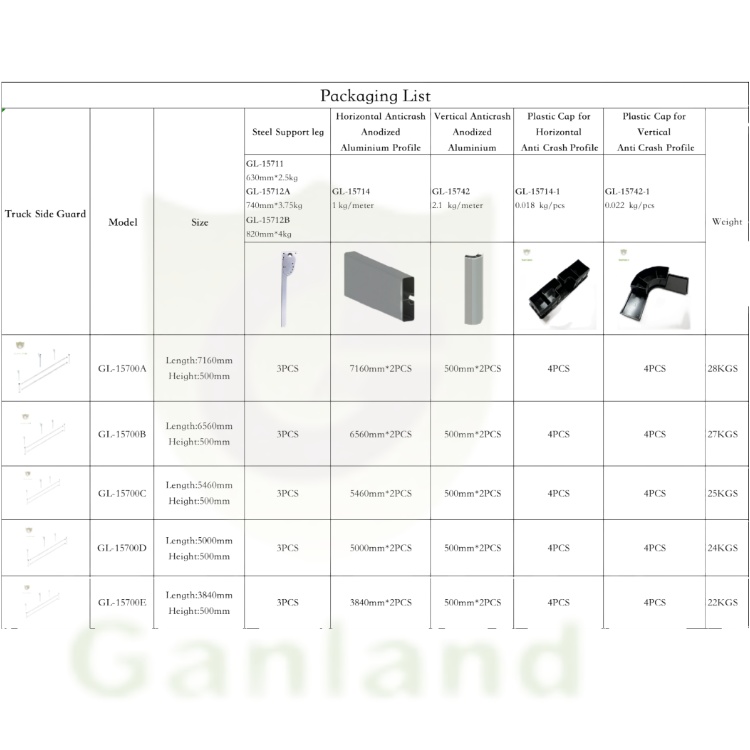
Ganland Auto Parts manufactures the complete truck side guard system: horizontal aluminum rail GL-15714 with T-slot design, corner aluminum profile GL-15742 with plastic connectors GL-15742-1, end caps GL-15714-1, steel mounting brackets GL-15711, GL-15712A/B/C/D (multiple lengths), and rivets plus T-slot insert screws included in kits.
Custom manufacturing available: rail lengths cut to your chassis dimensions, bracket heights matched to your chassis, and powder coating in any color. 8-year Gold Supplier, exports to 60+ countries. Request a quote at sales3@gl-truck.com or WhatsApp +86 173 6732 1309.
Related Posts