




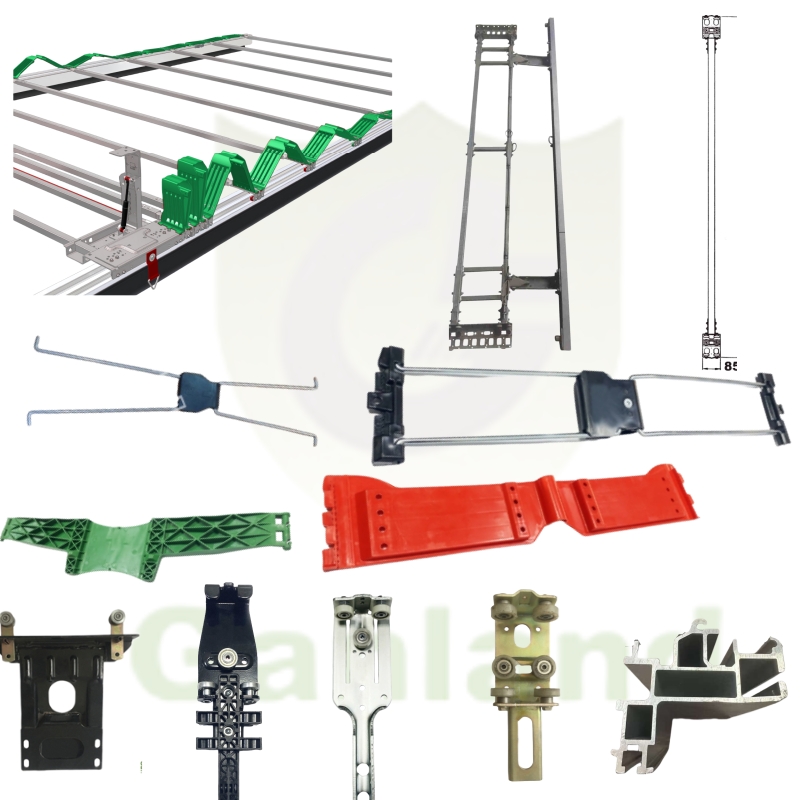
Curtain Sider Roof Systems Guide: Types, Tracks, Rollers, Installation & Maintenance
Introduction: Why the Roof System Matters
The roof is the most overlooked part of a curtainsider — until it fails. It protects cargo from rain and sun, contributes to the body's structural rigidity, and in the case of sliding roofs, determines whether you can load long or overhead cargo. The right roof system and its supporting hardware (tracks, rollers, tensioners) directly affect loading flexibility, payload utilization and maintenance costs.
1. Curtain Sider Roof System Types
1.1 Fixed Hard-Shell Roof (Rigid Roof)
The most common configuration. A rigid metal or GRP roof panel spans the full length, supported by roof bows.
Pros:
- Best weather and theft protection
- Highest structural rigidity (helps EN 12642 XL certification)
- Zero roof maintenance
- Lower tare weight than sliding systems
Cons:
- No overhead access — loading is side/rear only
- Cannot carry over-length cargo protruding above deck
1.2 Sliding Roof System (Sliding Top)
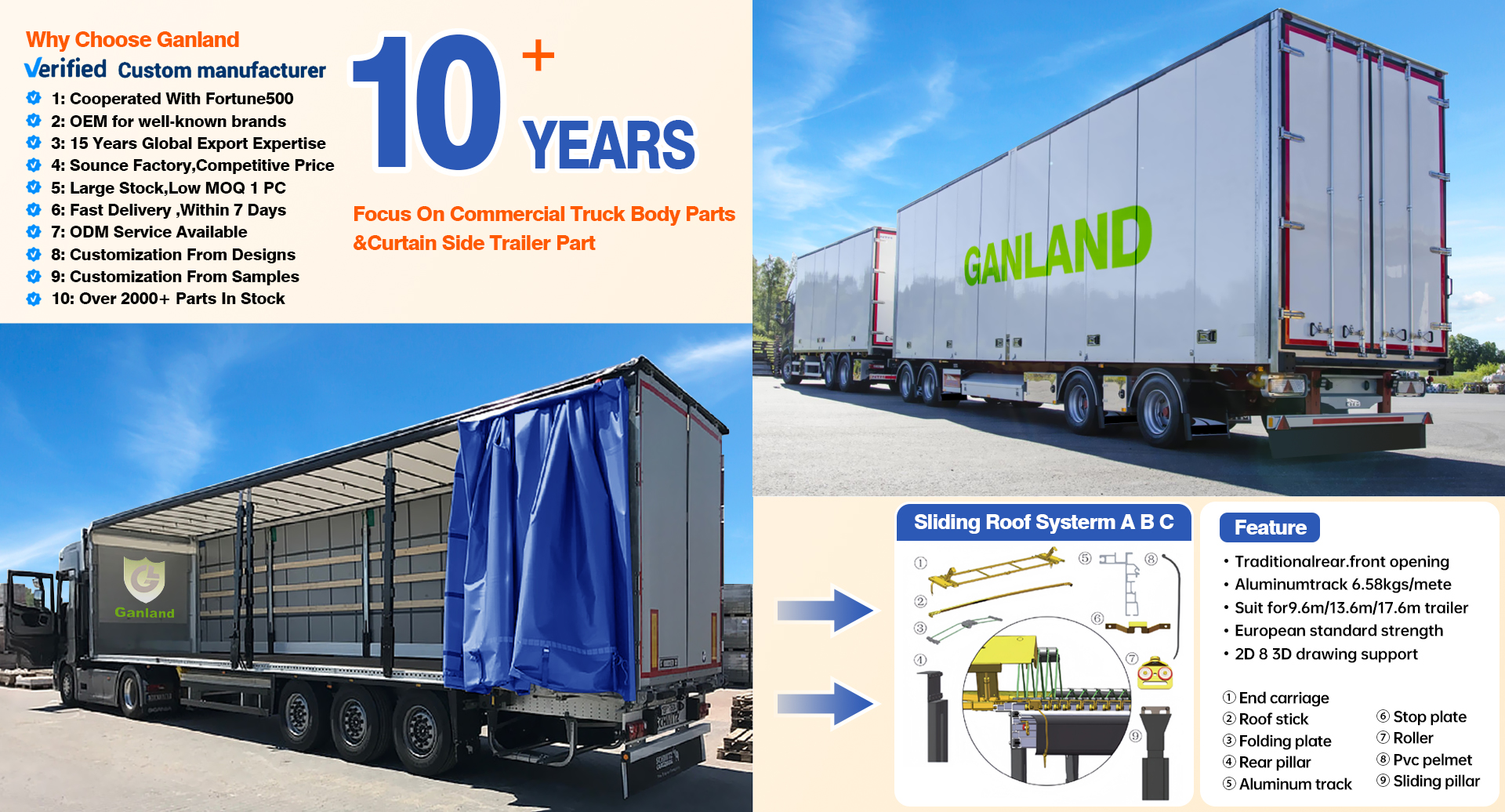
A canvas or light panel roof section slides forward/backward on dedicated roof tracks, opening an overhead hatch for crane or forklift loading of long cargo (timber, pipes, steel sections).
Variants:
- Front-opening: roof slides toward the front bulkhead (most common)
- Rear-opening: opens toward the rear doors
- Full-opening: nearly entire roof opens
Pros:
- Overhead crane/forklift loading of over-length goods
- Combines side-loading flexibility with partial roof protection
- Can be manual (crank) or motorized
Cons:
- Adds ~150-300 kg tare weight
- Moving parts require lubrication and inspection
- Roof canvas needs periodic replacement (every 5-8 years)
1.3 Lift-Up / Roof-Lifting System
The entire roof lifts vertically on scissor or hydraulic mechanisms, creating headroom for tall loads.
Pros:
- Full-length, full-width overhead opening
- Enables Mega-height loading scenarios
Cons:
- Most complex and expensive system
- Heaviest roof option
- More failure points
1.4 Full Tarpaulin / Roll-Up Roof (Conestoga-Style)
A continuous tarpaulin roof that rolls back like a flatbed tarp, used mainly on Conestoga trailers.
Pros:
- Full overhead access
- Lightest roof option
- Simplest mechanism
Cons:
- Lowest structural rigidity
- Weaker weather protection
- Load must be properly secured
Comparison Table
| Feature | Fixed Hard Shell | Sliding Roof | Roof-Lift | Full Tarp |
| Overhead access | No | Partial/full | Full | Full |
| Structural rigidity | Highest | Medium | Medium | Lowest |
| Tare weight | Low | +150-300 kg | Highest | Lowest |
| Maintenance | None | Medium | High | Medium |
| Weather protection | Excellent | Good | Good | Moderate |
2. Track Systems: The Backbone
2.1 Track Material Options
Aluminum extruded track (recommended)
- Material: 6063-T5 aluminum alloy, anodized or powder-coated
- Wall thickness: 1.0-2.5 mm
- Tolerance: +/-0.1-0.3 mm
- Lightweight, corrosion-resistant, precise profiles
Steel track
- Heavier but stronger; common on cheap trailers or high-abuse operations
- Must be galvanized or painted to prevent rust
Tapered/captive rails
- Sealed ball bearing tapered rollers combined with captive aluminum extruded tapered roof rails
- Lower friction, quieter operation
2.2 Track Profile Types
- C-channel: common for bottom rails, accepts strap hooks
- T-slot / tapered: used for top rails with captive rollers
- Flat bar + roller: simple bar track where rollers straddle the bar (e.g., 32 mm bar width)
2.3 Track Layout
- Top rail: carries the curtain roller carriages
- Bottom rail: guides curtain hem, receives strap hooks
- Roof rail (sliding roofs): dedicated track for the roof carriage; must be aligned within 1-2 mm across the trailer length
3. Rollers: The Moving Parts That Take the Wear
3.1 Bearing Type
| Type | Lifespan | Friction | Cost |
| Sealed ball bearing | 2-4+ years | Low, smooth | Higher |
| Plain (bush) bearing | 6-18 months | Higher | Lower |
| Roller bearing (double) | 4+ years | Lowest | Highest |
Sealed ball bearing rollers are the industry recommendation — they need no lubrication and keep the curtain easy to pull even after years of service.
3.2 Wheel Specifications
- Dia 30mm x W 19.3mm — light/medium curtains (economical)
- Dia 30mm x W 32-33.5mm — European standard (ball bearing)
- Dia 33.5mm wheel / 32.5mm face — MB-type replacement
- Double roller (twin castor) — heavy curtain / roof carriage use
3.3 Wheel Material
- Nylon/plastic: quiet, low friction, adequate for side curtains
- Steel (galvanized): longer life, heavier, for roof carriages
- Zinc-plated steel shank: standard mounting
3.4 Roller Spacing
- Side curtains: one roller every 400-500 mm along the top hem
- Sliding roof: rollers at every roof bow / 500-600 mm
4. Complete Curtain Sider Parts List
| Component | Function | Typical Spec |
| Top rail (aluminum) | Guides curtain rollers | 6063-T5, 1.0-2.5 mm wall |
| Bottom rail (aluminum) | Guides hem, holds strap hooks | C-channel profile |
| Curtain rollers | Allow curtain travel | 30-33.5 mm dia, ball bearing |
| Curtain fabric (tarpaulin) | Side/top wall | 900 gsm PVC-coated polyester |
| Over-center buckles | Bottom tension | Galvanized steel, ~1/m |
| Polyester straps | Connect curtain to rail | 2 inch (50 mm) wide |
| Ratchet tensioners | Fore/aft curtain tension | Square 12x12 etc. |
| Roof carriage rollers | Sliding roof movement | Heavy-duty double roller |
| Flexible pillars | XL positive-fit support | Fiberglass/steel |
| Batten pockets & battens | Reinforce canvas edges | Aluminum sections |
| Sealing gaskets | Weather sealing | EPDM rubber |
5. Installation: Step-by-Step
Sliding Roof Installation
- Mount roof rails — fit aluminum roof tracks along both top side rails; verify alignment within 1-2 mm over full length.
- Fit roof carriage rollers — attach heavy-duty double rollers to the roof frame cross-members.
- Assemble roof canvas — lay tarpaulin over the frame; insert batten pockets and battens.
- Hang canvas on rollers — clip the canvas leading edge to the front carriage; ensure smooth travel.
- Fit tension straps — connect canvas to the rear frame; tension evenly.
- Test operation — slide roof fully open and closed 3-5 times; check for binding, adjust rail alignment if needed.
Side Curtain Installation
- Fit top and bottom rails to the body.
- Attach rollers to curtain top hem (400-500 mm spacing).
- Hang curtain into top rail; verify free travel.
- Hook bottom straps under the rail; adjust over-center buckles.
- Fit and tension ratchet tensioners fore/aft.
- Re-tension after the first loaded run.
6. Maintenance Schedule
Monthly
- Inspect curtain/roof fabric for cuts, seam fatigue, UV embrittlement
- Check over-center buckles for deformation or seized pivots
- Verify roof slides full travel without binding
Quarterly
- Lubricate roller bearings and rail channels with dry PTFE spray (sealed bearings need none)
- Inspect track for dents, wear, or debris
- Check strap webbing for fraying at hooks
Annual
- Replace any flattened or cracked rollers before they damage the rail
- Re-tension all straps and tensioners
- Inspect roof canvas seams; repair with vinyl glue or heat gun
- Check batten pockets and sealing gaskets
Replacement Intervals (typical)
- Side curtain rollers: 2-4 years (ball bearing) / 6-18 months (plain)
- Roof carriage rollers: 4+ years
- Curtain fabric: 3-5 years (side) / 5-8 years (roof)
- Straps and buckles: replace worn or deformed immediately
7. FAQ
What is the difference between a fixed roof and a sliding roof curtainsider?
A fixed hard-shell roof is a permanent rigid panel with the best weather protection and rigidity but no overhead access. A sliding roof opens an overhead hatch for crane/forklift loading of over-length cargo, at the cost of higher tare weight and more maintenance.
Which track material should I choose?
Aluminum extruded 6063-T5 track is the industry standard — lightweight, corrosion-resistant, precise. Steel track is heavier but stronger for high-abuse operations. Ensure roller profile matches the track profile.
What roller size do I need?
The most common European standard is a sealed ball bearing roller with 30 mm wheel diameter (33.5 mm for MB-type replacements). Use heavy-duty double rollers for roof carriages.
How often should curtain rollers be replaced?
Sealed ball bearing rollers typically last 2-4 years with normal use. Replace them as soon as travel becomes stiff or the wheel shows flat spots — worn rollers damage the rail channel.
Can I add a sliding roof to my existing curtainsider?
Yes, sliding roof retrofits are available. It requires installing roof rails, carriage rollers and a canvas roof section — a qualified bodybuilder should do the work.
How do I prevent curtain flutter at highway speed?
Ensure over-center buckles are correctly adjusted and ratchet tensioners are tight. Replace worn buckles and stretched straps. Proper tension prevents sag and flutter.
What does "positive fit" mean for roofs?
Positive-fit (XL) systems combine curtain, flexible pillars and reinforced top rail so the structure withstands 40% of rated payload to the side without lashing. The roof rail and pillars are key structural elements in this certification.
8. Ganland: Complete Curtain Sider Roof & Track Parts
Ganland Auto Parts manufactures the full hardware range for curtain sider roof and side systems: aluminum track profiles (top rail, bottom rail, roof rail), ball bearing curtain rollers (30 mm, galvanized, double roller), roof carriage rollers for sliding systems, over-center buckles and strap kits, ratchet tensioners (square 12x12), PVC tarpaulin (900 gsm, custom cut and printed), flexible pillars, batten pockets and sealing gaskets.
All parts are available for custom manufacturing to your drawings, with 8-year Gold Supplier credentials and exports to 60+ countries. Request a quote at sales3@gl-truck.com or WhatsApp +86 173 6732 1309.
Related Posts