




Box Truck Body Guide: Types, Materials, Door Systems & Hardware Selection
Introduction: The Body Is a System
A box truck (van body) is more than a box on a chassis. It is a system of panels, frames, doors and hardware that must work together - the body panels provide structure and weather protection, while the doors, locks, hinges, seals and bumpers control access, security and durability. Understanding body types, panel materials and hardware specifications is essential for anyone buying, building or maintaining a van body.
1. Box Truck Body Types
1.1 Aluminum Body
Panels and frame built from aluminum sheets and extrusions.
Pros: Lightest option (higher payload), corrosion resistant, long service life, recyclable.
Cons: Higher initial cost, panels dent more easily than steel, requires skilled repair.
Best for: Dry freight, fleets prioritizing payload and long-term durability. A typical aluminum body can save 150-300 kg versus steel.
1.2 Steel Body
Panels and frame from galvanized or painted steel.
Pros: Strongest impact resistance, lowest material cost, easy to repair with welding.
Cons: Heaviest option, corrosion risk if galvanizing/paint is damaged.
Best for: Construction, waste, high-abuse applications where impact resistance matters more than weight.
1.3 GRP / FRP Body (Fiberglass Reinforced Plastic)
Molded fiberglass panels, often over a plywood or composite core.
Pros: Lightweight, corrosion resistant, no fasteners on exterior (smooth walls), excellent for interior cleaning, repairable.
Cons: Higher cost than steel, can crack under severe impact, panel repairs need specialized materials.
Best for: Food service, pharmaceuticals, courier fleets - clean interiors and easy washing.
1.4 Sandwich Panel Body (Insulated Composite)
Composite panels with a rigid core (PU foam, XPS, EPS) between two skin layers (aluminum, steel, GRP). The core provides both structure and insulation.
Pros: Excellent insulation, high stiffness-to-weight ratio, clean interior surface, the standard for refrigerated and freezer bodies.
Cons: Highest cost, panel damage may expose the core to moisture.
Best for: Refrigerated/freezer transport, temperature-sensitive freight, and modern dry-freight bodies where insulation is a bonus.
Body Type Comparison
| Feature | Aluminum | Steel | GRP/FRP | Sandwich Panel |
| Weight | Lightest | Heaviest | Light | Light-Medium |
| Impact resistance | Medium | Highest | Medium | Medium-High |
| Corrosion resistance | Excellent | Poor (if coated) | Excellent | Excellent |
| Insulation | None | None | Low | Excellent |
| Interior cleaning | Good | Good | Excellent | Excellent |
| Relative cost | High | Low | High | Highest |
2. Box Truck Components: Complete List
Structural and panel components: floor (aluminum tread plate, steel, or plywood), side walls and roof panels, front bulkhead, roof bows and side posts, rear frame.
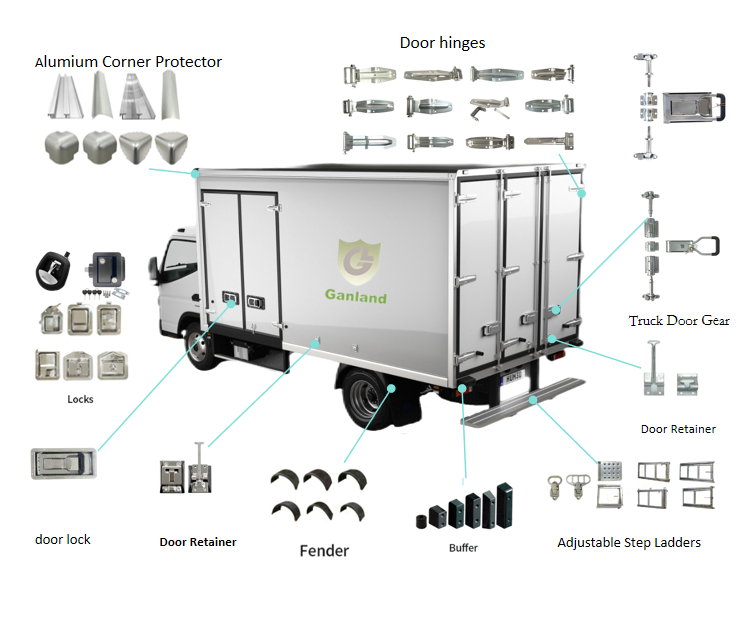
Door system components: rear doors, door hinges, door locks and locking rods, door retainers, door seals.
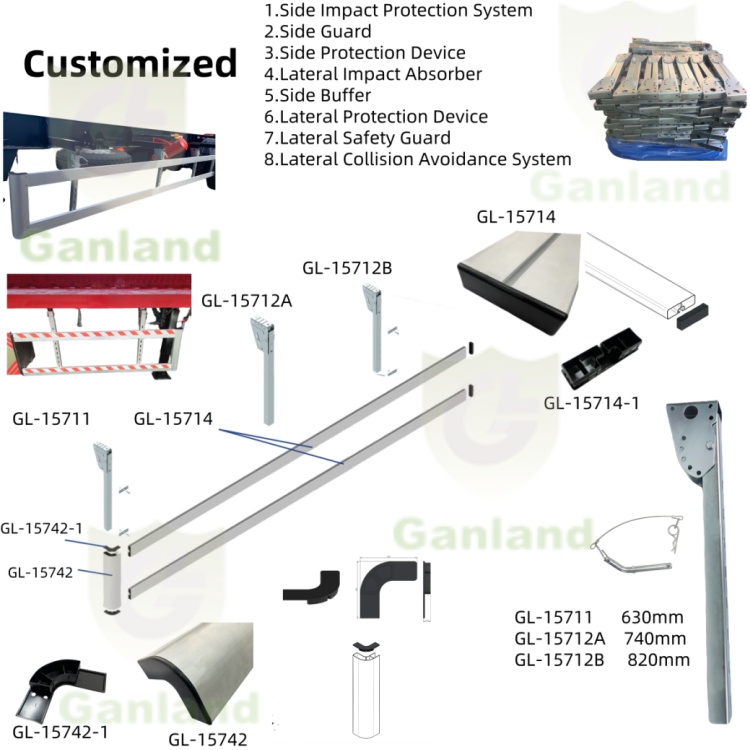
Edge and protection components: edge trim (aluminum profiles along panel edges), corner protectors, rubber bumpers/buffers, scuff liners.
Other hardware: roof vents, tie-down points and lashing rings, mudguards and brackets, reflectors.
3. Door Types & Door Materials
3.1 Door Types
| Door Type | Operation | Best For |
| Twin rear doors (bifold) | Two hinged doors, open outward | Standard dry freight, general cargo |
| Roll-up door | Curtain-style door rolls up on tracks | Frequent loading, tight dock spaces |
| Swing doors with vertical lock rods | Rear doors with multi-point rod locking | Security-sensitive freight |
| Side doors | Single or sliding doors on the side wall | Side loading operations |
| Wing doors (wing van) | Full-side panels lift up | Long cargo, forklift side access |
3.2 Door Materials
| Material | Properties | Typical Use |
| Steel | Strong, heavy, needs galvanizing/paint | Standard rear doors, security |
| Aluminum | Light, corrosion resistant, dents | Lightweight rear and side doors |
| GRP / FRP | Smooth, clean, corrosion resistant | Food/pharma van rear doors |
| Sandwich panel | Insulated, stiff, clean | Reefer and freezer doors |
| Roll-up curtain | Flexible, light, fast | Roll-up rear doors |
4. Rear Door Locks: Types & Specifications
4.1 Cam Door Locks (Cam Action Locking Gear)
The most common system for van and trailer rear doors. A handle turns a rod with cams (locks) at top and bottom that engage keepers on the door frame.
Key specifications:
- Tube/rod diameter: 16mm, 21mm, 27mm, 34mm - must match the door frame hardware
- Handle type: flush handle (recessed), T-handle, lever handle
- Material: steel with zinc plating, or 304 stainless steel for corrosion environments
- Left/right hand: orientation must match the door side
- Components: 2 cams, 2 keepers, brackets, handle, handle bracket
4.2 Bolt / Rod Locking Systems
Multiple locking bolts on a vertical rod engage strikes at several points. Common on swing doors requiring multi-point security. Specifications: rod diameter (often 12-16mm), number of locking points (2-4), material and finish.
4.3 Choosing a Lock System
| Application | Recommended |
| Dry freight, standard | Zinc-plated steel cam lock, 21-27mm |
| Refrigerated / freezer | 304 stainless steel cam lock |
| High-value cargo | Cam lock + key lock, or multi-point bolt system |
| Marine / coastal (corrosion) | 304 stainless steel throughout |
| Budget rebuilds | Galvanized steel cam lock, standard rod |
5. Door Hinges: Material & Specifications
5.1 Materials
| Material | Properties | Best For |
| Galvanized steel | Strong, corrosion protected, economical | Standard rear doors |
| 304 stainless steel | Excellent corrosion resistance, premium finish | Reefer, marine, food transport |
| Steel (painted/zinc) | Lowest cost, adequate for dry use | Budget applications |
5.2 Common Specifications
- Length: typically 8", 10", 12" for truck rear doors
- Pin diameter: 6-12mm depending on door weight
- Mounting: bolt-on (most common, replaceable) or weld-on
- Weight capacity: match hinge rating to door weight
- Finish: galvanized, zinc-plated, or stainless
5.3 Selection Guide
- Count hinges per door: heavy steel doors need 3-4 hinges; aluminum doors 2-3
- Corrosion environments: always 304 stainless
- Bolt-on hinges are preferred for maintainability
- Check pin wear: loose doors indicate worn hinge pins
6. Edge Trim: Material & Function
Edge trim (aluminum edge profiles) protects panel edges from chipping and moisture ingress, and gives the body a finished look.
Materials: aluminum profiles (6063-T5, standard - L-profile, U-profile, Z-profile, flat bar), PVC/plastic trim (flexible, low cost), stainless steel (high-abuse edges).
Functions: protects panel edges from impact and delamination, prevents water penetration at panel joints, covers raw panel edges, some profiles double as mounting channels for seals.
Selection guide: roof and side edges - aluminum L or U profile; floor edges (high wear) - stainless or heavy aluminum angle; door frame edges - profile with integrated seal channel.
7. Corner Protectors
Corner protectors shield the most vulnerable points of the body - the top rear corners, front top corners, and floor corners - from dock impact and tree branches.
Types: metal corner caps (aluminum or steel, bolted or riveted), rubber/plastic corner guards (flexible, impact absorbing), full corner wrap (formed metal covering two adjacent faces).
Selection guide: top rear corners - aluminum caps or rubber guards; floor corners - steel or heavy aluminum (dock impact zone); reefer bodies - corner protectors with integrated seal retention.
8. Door Seals: Material & Specifications
8.1 Materials
| Material | Temperature Range | Properties | Best For |
| EPDM rubber | -40C to +120C | Excellent UV/ozone resistance, long life | Standard dry vans - industry default |
| PVC seal | -20C to +60C | Economical, flexible | Budget applications, moderate climates |
| Sponge rubber | -40C to +100C | Soft, compressible, good sealing | Sealing against uneven surfaces |
| Silicone | -60C to +200C | Extreme temperature resistance | Freezer and special applications |
8.2 Common Profiles
- P-profile / bulb seal: hollow bulb compresses against the door - most common rear door seal
- D-profile: solid bulb, heavier sealing pressure
- E-profile: hollow with mounting lip, push-on installation
- Trim-lock / push-on trim: grips the panel edge, no adhesive needed
8.3 Installation Methods
- Push-on (trim lock): presses onto the panel edge - replaceable without tools
- Adhesive-backed: peel-and-stick for smooth surfaces
- Screw-on: with metal retainer - most secure for heavy abuse
8.4 Selection Guide
- Standard rear doors: EPDM P-profile, push-on or adhesive
- Reefer/freezer: EPDM or silicone, screw-on with retainer
- Damaged/uneven door frames: sponge rubber for extra compression
- Check seal compression regularly - a compressed or torn seal causes water ingress and energy loss in reefer units
9. Rubber Bumpers & Buffers
9.1 Materials & Properties
| Material | Properties | Best For |
| Solid rubber | Durable, high compression strength | Heavy-duty door stops, dock bumpers |
| EPDM rubber | Weather and ozone resistant | Outdoor applications |
| Nitrile rubber | Oil and fuel resistant | Workshops, fuel environments |
| Polyurethane | High abrasion resistance | Floor bumpers, high-impact zones |
9.2 Common Applications & Specifications
- Door stop buffers: mount on the door or frame to limit over-travel - cylindrical or rectangular, with bolt holes or studs
- Dock bumpers: large rubber blocks on the rear frame, often steel-reinforced
- Tailgate buffers: protect the tailgate when lowered
- Corner buffers: small pads at door edges
Specification points: hardness (Shore A, typically 60-90), size, mounting (bolt-through, stud, adhesive), and whether steel reinforcement is needed.
9.3 Selection Guide
- Door stop buffers: 60-80 Shore A rubber, bolt-on
- Dock bumpers: steel-reinforced rubber blocks, sized to the frame
- Reefer applications: EPDM (temperature stable)
- High-abuse floors: polyurethane
10. Application Matrix: Matching Components to Body Type
| Body Type | Recommended Door | Lock | Hinge | Seal | Bumper |
| Aluminum dry freight | Aluminum twin doors | Zinc steel cam lock 27mm | Galvanized steel 10-12 inch | EPDM P-profile | Rubber door stop |
| Steel body | Steel twin doors | Zinc steel cam lock 27mm | Galvanized steel heavy | EPDM P-profile | Rubber, heavy duty |
| GRP/FRP (food/pharma) | FRP doors | 304 stainless cam lock | 304 stainless | EPDM, adhesive | EPDM |
| Reefer/freezer | Sandwich panel doors | 304 stainless cam lock | 304 stainless | EPDM/silicone screw-on | EPDM |
| Wing van | Wing doors + rear doors | Zinc steel + rod locks | Steel/galvanized | EPDM P-profile | Rubber stops |
11. FAQ
Which box truck body type is best?
It depends on your operation. Aluminum is lightest for payload-focused dry freight; steel is strongest for abuse; GRP/FRP offers the cleanest interior for food and pharma; sandwich panels are required for temperature-controlled cargo.
Aluminum or FRP body - which should I choose?
Aluminum is lighter and corrosion resistant but dents; FRP has a smooth, easy-to-clean interior and no exterior fasteners but costs more. Choose aluminum for payload, FRP for cleanability.
What cam door lock rod size do I need?
Rod sizes are 16mm, 21mm, 27mm and 34mm. 27mm is the most common for standard van and trailer rear doors. Match the rod to the existing keepers and brackets on the door frame.
Stainless steel or galvanized hardware?
Galvanized steel is economical and fine for dry operations. Choose 304 stainless steel for reefer bodies, coastal/marine environments, or anywhere salt, humidity or cleaning chemicals are present.
How do I choose a door seal?
Use EPDM P-profile push-on or adhesive seals for standard rear doors. For reefer/freezer bodies choose EPDM or silicone with screw-on retainers. Sponge rubber seals suit uneven frames.
How many hinges does a truck rear door need?
Heavy steel doors typically need 3-4 hinges per door; lighter aluminum doors need 2-3. Match hinge length (8-12 inches) and pin diameter to the door weight.
What is edge trim for?
Edge trim (aluminum profiles) protects panel edges from chipping and moisture ingress and gives a finished look. Use stainless or heavy aluminum at high-wear edges like the floor.
12. Ganland: Complete Box Truck Body Hardware
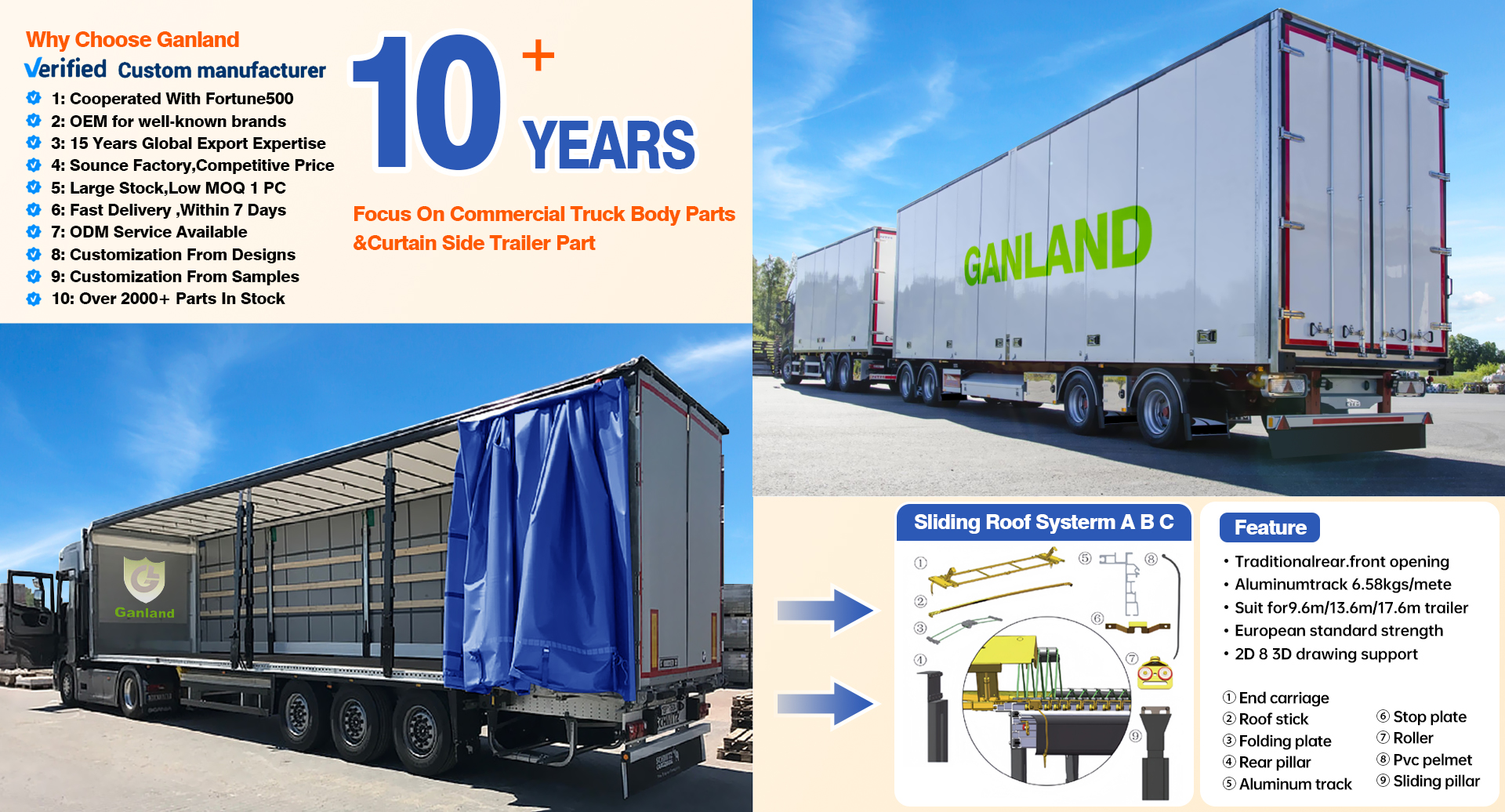
As a manufacturer specializing in truck body parts, Ganland Auto Parts supplies the full hardware range for box truck bodies: cam door locks (16/21/27/34mm, steel and 304 stainless steel), door hinges (steel, galvanized, 304 stainless, 8-12 inch), edge trim profiles and corner protectors (aluminum, steel, rubber), EPDM and PVC door seals (P/D/E profiles), rubber bumpers and buffers, door retainers, fasteners and full locking gear.
All components are available for custom manufacturing to your technical drawings, with 14-year Gold Supplier credentials and exports to 60+ countries. Request a quote at
sales3@gl-truck.com or
WhatsApp +86 173 6732 1309.
Tags:
Related Posts