




Complete guide to curtain side trailers (tautliners). EN 12642 Code L & XL standards explained, leading brands compared (Schmitz Cargobull, Krone, Kogel, Wielton), installation steps, PVC tarpaulin technology and maintenance tips.
What Is a Curtain Side Trailer?
A curtain side trailer — also known as a curtainsider or tautliner — is a semi-trailer whose side walls are made of tensioned, flexible PVC-coated polyester curtain fabric instead of rigid panels. The curtain slides along top and bottom rails, giving forklift side-loading access along the full length of the trailer while keeping the load protected from weather and theft.
Curtainsiders dominate European dry-freight transport because they combine the security of a box trailer with the loading convenience of a flatbed. They are widely used for general cargo, palletized goods, building materials and double-deck operations.
1. Curtain Side Trailer Standards: EN 12642 Code L vs XL
The most important standard for curtain side trailers is EN 12642:2016 — the European load containment standard for vehicle bodies and trailers with a maximum authorized mass above 3,500 kg.
Code L (Standard Body)
- Body structure certified to withstand a defined minimum horizontal load at the sides, front and rear.
- Suitable for general cargo where additional load restraint (lashing, blocking) is used.
- The curtain itself is NOT certified to restrain the load — the side structure provides only partial containment.
Code XL (Reinforced Body) — the "XL" advantage
- The complete body structure (curtains included) is tested as a single certified system.
- An XL-certified curtainsider can withstand a minimum of 40% of the rated payload applied to the side without additional lashing.
- This means many loads can be carried without individual lashing — faster loading, lower consumable cost, and better payload utilization.
- Certification is issued by the trailer OEM and shown with an XL sticker on the trailer front.
Why XL matters for operators
- Reduces lashing time per stop (up to 30-40% faster loading cycles).
- Fewer straps and edge protectors purchased each year.
- Enables safe double-deck and high-density pallet loading.
- Required by many retail and grocery shippers as a contractual condition.
Related standards
| EN 12642:2016 | Load containment, Code L & XL |
| EN 12195-1 | Lashing force calculation |
| CTU Code (IMO/ILO/UNECE) | Cargo transport unit packing guidelines |
2. Leading Curtain Side Trailer Brands (Market Overview)
The European curtainsider market is dominated by a handful of OEMs. Krone and Schmitz Cargobull together account for more than 50% of EU trailer production.
Schmitz Cargobull (Germany)
- Europe's largest trailer manufacturer.
- Flagship: S01 curtainsider, curb weight from ~5,780 kg.
- Known for modular production, high resale value, and strong XL-certified bodies.
- Typically priced 60,000 EUR+ for a new spec.
Krone (Germany)
- Co-leader with Schmitz Cargobull; huge curtainsider range (Dry Liner, Profi Liner).
- Famous for low maintenance cost and long service intervals.
- Strong dealer and parts network across Europe.
Kogel (Germany)
- Cargo and Vario curtainsider lines; recognized for the strongest steel frames in the segment.
- Competitive pricing; popular in Central and Eastern Europe.
Wielton (Poland)
- Europe's third-largest trailer group.
- Aggressive price-performance positioning; fast-growing across EU fleets.
Montracon (UK)
- Major UK builder of XL-certified curtainsiders; also lightweight aluminum designs.
Others worth knowing
- Tirsan (Turkey) — cost-effective, popular in Eastern Europe and Middle East.
- Kassbohrer (Germany) — premium, low-tare engineering.
- Faymonville (Belgium) — specialized and custom builds.
3. How a Curtain Sider Is Installed: Component-by-Component
Component 1: Top and bottom rails (tracks)
- Aluminum extrusions mounted along the full length of the trailer sides.
- The top rail carries the curtain roller carriages; the bottom rail guides the curtain hem and receives the strap hooks.
- Rails must be aligned precisely (within 1-2 mm) over the trailer length, or curtains will bind.
Component 2: Curtain rollers
- Steel or plastic wheels fitted to the top of the curtain at 400-500 mm intervals.
- Ball-bearing rollers give smooth, low-effort curtain travel; plain rollers wear faster.
- Each roller bolts to the curtain top hem and clips into the top rail channel.
Component 3: Curtain fabric (tarpaulin)
- PVC-coated high-tenacity polyester, typically 900 gsm with 1000D yarn for heavy logistics.
- Coated vs laminated manufacturing affects durability.
- Customizable: cut-to-size, printed logos, top curtain, door curtain, rear flaps.
Component 4: Straps and buckles (bottom tension system)
- 2-inch polyester straps sewn to the curtain bottom, hooked under the bottom rail.
- Over-center buckles apply the final tension; correct adjustment prevents curtain sag and flutter.
- Buckle position: one per ~1 meter of curtain length.
Component 5: Tensioners
- Ratchet tensioners control fore/aft curtain tension.
- Proper tensioning prevents the curtain from rubbing the frame.
Component 6: Flexible pillars (optional)
- Removable fiberglass or steel poles at bay positions.
- Used in positive-fit (XL) setups where the curtain must not bow outward under load.
Typical installation sequence
- Fit top and bottom rails to the trailer body.
- Attach rollers to the curtain top hem.
- Hang the curtain into the top rail.
- Hook bottom straps under the rail; adjust buckles.
- Fit and tension the ratchet tensioners fore/aft.
- Test full curtain travel and re-tension after the first loaded run.
4. Technology & Materials: What Makes a Good Curtain
Fabric construction
- Base: high-tenacity polyester scrim (e.g., 1000D x 1000D, 30x30 weave).
- Coating: PVC applied by coating or lamination, both sides.
- Weight: 650 gsm (light) to 900 gsm (standard European) to 1100 gsm (heavy).
- Key specs: tensile strength, tear resistance, adhesion strength, UV resistance, temperature range (-30C to +70C).
Surface treatments
- Lamination — better flexibility, smoother finish, preferred for printed curtains.
- Hot-melt coating — higher adhesion, better edge sealing.
Hardware finishing
- Rollers: zinc-plated or galvanized steel; nylon wheels for quiet operation.
- Buckles & tensioners: galvanized steel, heavy-gauge.
- Stainless steel (304) upgrades for reefer/chemical environments.
Load security technology
- Positive-fit XL systems: curtain + flexible pillars + reinforced top rail = EN 12642 XL compliance without lashing.
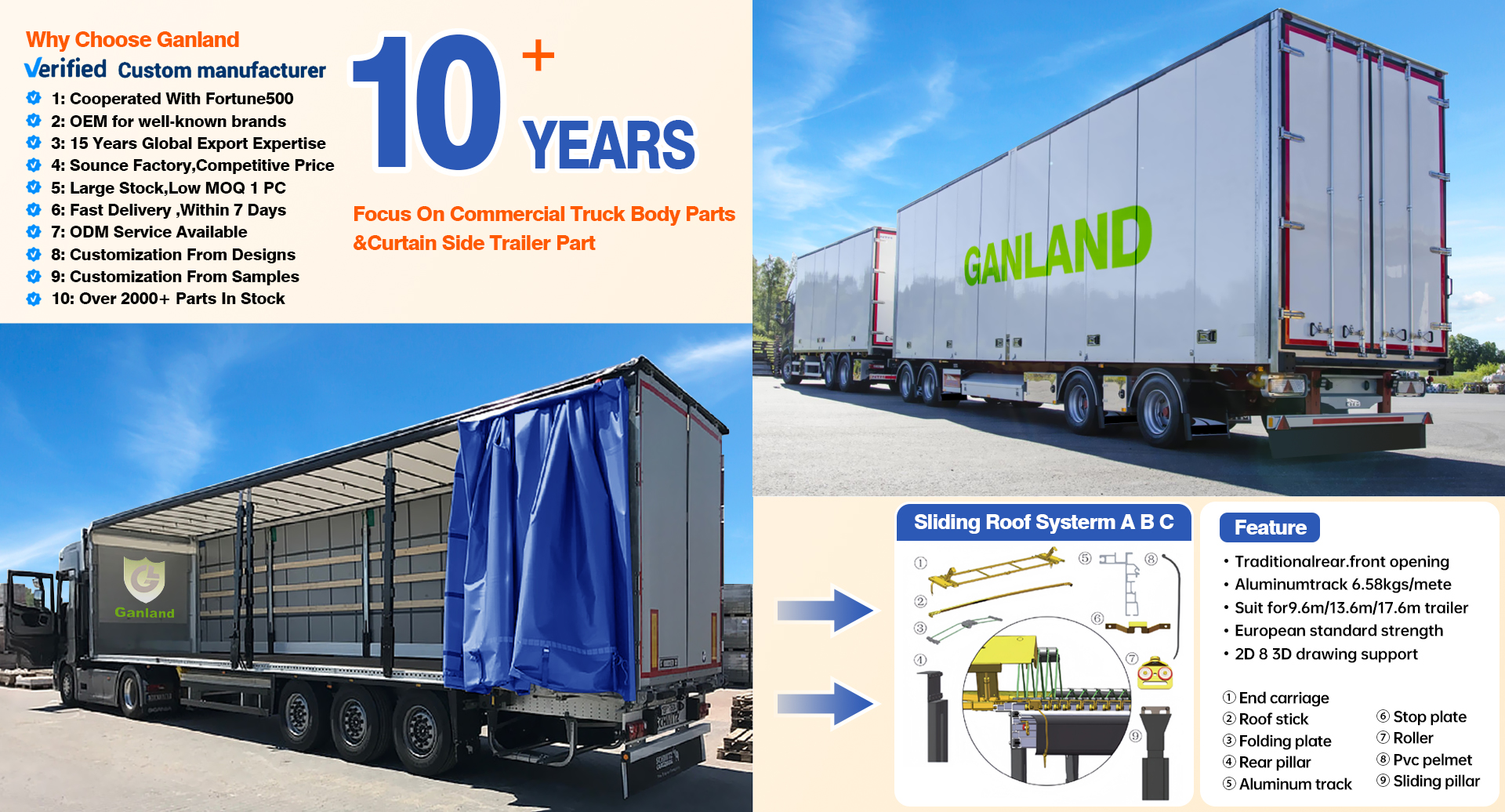
- Sliding roof systems: allow overhead crane loading.
5. Maintenance Best Practices
- Inspect curtain fabric monthly for cuts, seam fatigue, and UV embrittlement.
- Lubricate roller bearings and rail channels every 3 months (dry PTFE spray).
- Replace worn rollers before they damage the rail channel.
- Re-tension straps after first loaded trip; check buckles for deformation.
- Replace curtains every 3-5 years depending on mileage and climate.
6. Ganland: Your Curtain Sider Parts Source
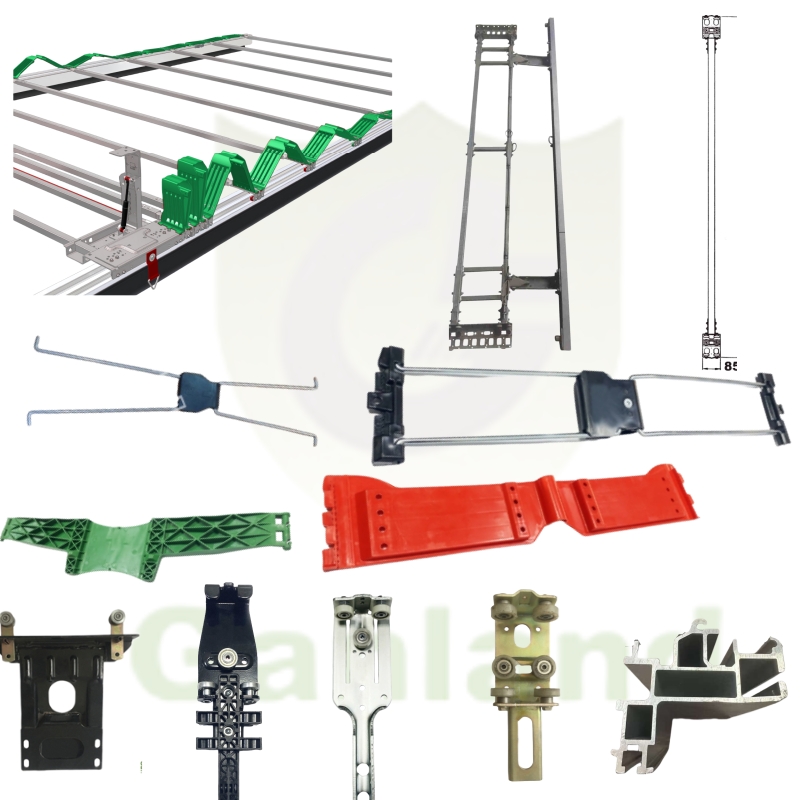
As a manufacturer specializing in truck body parts, Ganland Auto Parts supplies the complete curtainsider component range: curtain rollers (ball bearing, plastic, galvanized), over-center buckles and strap kits, ratchet tensioners, PVC tarpaulin (custom cut, printed), aluminum profiles and track systems, and flexible pillars.
All components are available for custom manufacturing to your technical drawings, with 8-year Gold Supplier credentials and 60+ export countries. Request a quote at sales3@gl-truck.com or WhatsApp +86 173 6732 1309.
Frequently Asked Questions
What is the difference between EN 12642 Code L and Code XL?
Code L is a standard body with partial side containment; Code XL is a reinforced, fully certified body where the complete structure (including curtains) withstands at least 40% of rated payload to the side without additional lashing.
How much does a new curtain side trailer cost?
New European curtainsiders range from roughly 60,000 EUR (volume brands like Wielton) to 80,000 EUR+ (premium Schmitz Cargobull/Krone specs). Used trailers start around 11,000-17,000 EUR.
Can any curtainsider be XL certified?
No. XL certification is a structural test of the complete body by the OEM at manufacture. Retrofitting XL generally requires replacing the top rail, curtains, and adding flexible pillars.
How often should curtain rollers be replaced?
With regular lubrication, ball-bearing rollers typically last 2-4 years. Replace them as soon as travel becomes stiff or the wheel surface shows flat spots.
What fabric weight should I choose?
900 gsm is the European standard for mixed long-haul. Choose 650-750 gsm for light regional work to save weight, and 1000+ gsm for construction or mining operations.
Can curtain side fabric be printed with our logo?
Yes. PVC-coated polyester accepts direct printing; many fleets print branding, rear advertising and safety markings. Provide artwork to your parts supplier and they will cut and print to size.
Related Posts